The supplement label says “Vitamin E — 400 IU.” What it does not say: that there are eight distinct Vitamin E molecules, that synthetic dl-alpha is only one of them, that it is petroleum-derived, and that natural mixed tocopherols deliver up to 3x the bioactivity. This is the form gap the industry hopes you never learn about.
The Label vs. The Biology
Vitamin E is not a single compound. It is a family of eight lipid-soluble antioxidants: four tocopherols (alpha, beta, gamma, delta) and four tocotrienols (alpha, beta, gamma, delta). Each has a distinct molecular structure, a distinct tissue distribution, and a distinct biological function. Alpha-tocopherol prevents LDL oxidation. Gamma-tocopherol scavenges reactive nitrogen species that alpha cannot touch. Delta-tocopherol suppresses NF-kappaB inflammation signaling. Tocotrienols penetrate deeper into lipid membranes and may protect neurons in ways tocopherols cannot.
Yet the typical multivitamin contains one form only: synthetic dl-alpha-tocopheryl acetate. A petroleum-derived molecule that the body recognizes as foreign, converts inefficiently, and that actively displaces the other seven forms from circulation. The label says “400 IU.” The biology says “one-eighth of the nutrient family, in its least useful configuration.”
The Eight-Molecule Problem
To understand why this matters, you must first abandon the idea that “Vitamin E” is a single thing. It is not. It is a consortium of eight molecules that evolved together in food — nuts, seeds, leafy greens, vegetable oils — and that work synergistically in human tissue. Here is what each form does that the others do not:
- Alpha-tocopherol: The most potent chain-breaking antioxidant in cell membranes. Prevents lipid peroxidation and LDL oxidation. This is the form the RDA measures — and the only form most supplements contain.
- Gamma-tocopherol: The dominant form in the American diet. Scavenges peroxynitrite, a reactive nitrogen species that alpha-tocopherol cannot neutralize. Peroxynitrite drives vascular inflammation and may contribute to cardiovascular disease independent of LDL oxidation.
- Delta-tocopherol: Suppresses NF-kappaB, the master inflammation switch. At concentrations achievable through supplementation, delta inhibits COX-2 expression and may reduce chronic inflammatory signaling.
- Beta-tocopherol: Less studied but present in food matrices. Contributes to membrane fluidity and may have complementary antioxidant roles in specific tissues.
- Alpha-tocotrienol: Crosses the blood-brain barrier more efficiently than tocopherols. Protects neurons from glutamate-induced toxicity. Emerging research links tocotrienols to neuroprotection in stroke and cognitive decline models.
- Gamma- and delta-tocotrienol: Potent cholesterol synthesis inhibitors via HMG-CoA reductase suppression — the same enzyme statins target, but without the drug mechanism. May support healthy lipid profiles.
When you take only alpha-tocopherol — especially the synthetic form — you are not supplementing Vitamin E. You are flooding one receptor pathway while starving five others.
The Natural vs. Synthetic Gap
The difference between natural and synthetic Vitamin E is not philosophical. It is stereochemical, and it has measurable biological consequences.
| Factor | Natural (d-alpha) | Synthetic (dl-alpha) |
|---|---|---|
| Source | Soybean, sunflower, or palm oil | Petroleum byproducts (toluene, acetone) |
| Stereochemistry | Single active isomer (R,R,R) | Racemic mixture: 8 isomers, only 1 active |
| Bioactivity vs. Natural | 100% (reference standard) | ~74% (1.35 IU synthetic = 1 IU natural) |
| Forms Included | Alpha only (in most products) | Alpha only |
| Tissue Retention | Higher — recognized by alpha-TTP | Lower — partially unrecognized and excreted |
| Impact on Other Forms | At high doses, may deplete gamma | Same problem, plus lower overall activity |
| Cost to Manufacturer | Higher | Very low |
The key number: synthetic dl-alpha has only 74% of the bioactivity of natural d-alpha at equivalent IU. But the real problem is deeper. The IU system itself was designed to measure anti-scurvy activity in rats — not the full antioxidant spectrum in humans. A 400 IU capsule of synthetic dl-alpha delivers the biological equivalent of roughly 300 IU of natural alpha, and it delivers zero gamma, zero delta, and zero tocotrienols.
Why dl-alpha Dominates the Shelves
The same three forces that dictate oxide forms for minerals also dictate dl-alpha for Vitamin E:
1. Density and label theater. Synthetic dl-alpha is concentrated and stable. A manufacturer can put “400 IU” on a tiny softgel, and the number looks impressive. Consumers have been trained to equate higher IU with higher quality. They do not know that IU measures one specific chemical reaction in rat liver, not the full antioxidant capacity of the nutrient family.
2. Cost. Natural mixed tocopherols cost 3–5x more than synthetic dl-alpha. The price difference is not trivial at scale. For a brand optimizing margins on a $25 multivitamin, the ingredient cost of Vitamin E is often under $0.05 per bottle. Natural mixed tocopherols would push that to $0.25 or more. Over millions of units, that is real money — and real biology lost.
3. Consumer ignorance and regulatory silence. The FDA does not require disclosure of natural vs. synthetic forms. The label simply says “Vitamin E.” A consumer cannot distinguish between a $0.02 petroleum derivative and a $0.30 cold-pressed extract without reading the ingredient list — and even then, “dl-alpha-tocopheryl acetate” is presented as if it were a real nutrient.
This is not conspiracy. It is regulatory architecture and economic optimization. The system is working exactly as designed. It is not designed for your cells.
The Gamma-Tocopherol Blind Spot
Here is a fact that should alarm anyone taking a standard multivitamin: gamma-tocopherol, not alpha, is the dominant form of Vitamin E in the American diet and in human tissue. Americans consume roughly 4–6 times more gamma than alpha from food sources. Yet gamma has been systematically ignored by the supplement industry because the RDA and the IU system only measure alpha.
Why does gamma matter? Two reasons:
Peroxynitrite scavenging. Alpha-tocopherol neutralizes lipid peroxides. Gamma-tocopherol neutralizes peroxynitrite, a reactive nitrogen species formed when nitric oxide reacts with superoxide. Peroxynitrite is a major driver of vascular inflammation, DNA damage, and mitochondrial dysfunction. Alpha cannot touch it. Gamma was evolved for it.
Prostate and inflammation data. The SELECT trial (Selenium and Vitamin E Cancer Prevention Trial) used synthetic dl-alpha at 400 IU daily and found no prostate cancer benefit. Some follow-up analyses even suggested harm at high doses. What the trial did not test — because it was not designed to — was whether natural mixed tocopherols, particularly gamma, would have performed differently. Separate observational data (Helzlsouer et al., 2000) found that higher plasma gamma-tocopherol was associated with lower prostate cancer risk, while higher alpha was not. The form matters more than the dose.
The IU System: Designed for Rats, Applied to Humans
The International Unit for Vitamin E was established in the 1940s based on the rat fetal resorption assay. A pregnant rat is deprived of Vitamin E until her fetuses resorb. Different forms are tested to see which prevent resorption. One IU equals the activity of 1 mg of synthetic dl-alpha-tocopheryl acetate in this assay.
Several problems:
- The assay measures only alpha activity. Gamma, delta, beta, and all tocotrienols have zero IU value in this system, even though they have independent biological functions.
- The assay is in rats. Human alpha-tocopherol transfer protein (alpha-TTP) has different stereochemical preferences than rat alpha-TTP. Natural RRR-alpha is retained better in humans than synthetic all-rac-alpha.
- The assay ignores membrane penetration. Tocotrienols penetrate deeper into lipid bilayers and may protect mitochondrial membranes that tocopherols cannot reach. This is invisible to the IU system.
The result: a 400 IU label tells you almost nothing about the actual antioxidant protection you are receiving. It is a number from a 1940s rat assay, applied to a complex human nutrient family, and weaponized for label theater.
The Tocotrienol Dimension
Most consumers have never heard of tocotrienols. Most supplement formulators would prefer they never do. Tocotrienols represent a parallel branch of the Vitamin E family with distinct, and in some cases superior, biological activity:
- Neuroprotection: Alpha-tocotrienol at nanomolar concentrations protects neurons from glutamate toxicity — the mechanism of excitotoxic injury in stroke and neurodegeneration. Tocopherols require micromolar concentrations for equivalent protection. (Sen et al., 2006)
- Cholesterol modulation: Gamma- and delta-tocotrienol inhibit HMG-CoA reductase, the rate-limiting enzyme in cholesterol synthesis, through a post-transcriptional mechanism distinct from statins. (Parker et al., 1993)
- Anti-cancer signaling: Tocotrienols suppress Akt/mTOR survival pathways in cancer cell lines more potently than tocopherols. (Wali et al., 2009)
Tocotrienols are more expensive to extract, less stable in formulation, and harder to standardize. These are manufacturing problems, not biological problems. The industry optimizes for shelf stability and margin. Your cells optimize for survival.
How to Read a Vitamin E Label
If you take nothing else from this essay, take this framework. Three questions:
1. What form? Look for “mixed tocopherols” or “d-alpha tocopherol.” If the label says “dl-alpha-tocopheryl acetate” or “dl-alpha-tocopherol,” you are buying a petroleum derivative with 74% of the bioactivity of the natural form, and only one of eight molecules.
2. What spectrum? Does the product contain gamma and delta tocopherols? Does it include any tocotrienols? If not, you are receiving a narrow-band antioxidant in a broad-spectrum body.
3. What dose, and what does it mean? 400 IU of synthetic dl-alpha equals roughly 300 IU of natural alpha in real bioactivity. And IU ignores gamma, delta, and tocotrienols entirely. A product with 200 IU of natural mixed tocopherols may deliver more total antioxidant protection than 400 IU of synthetic alpha.
What ZENYVA Does Differently
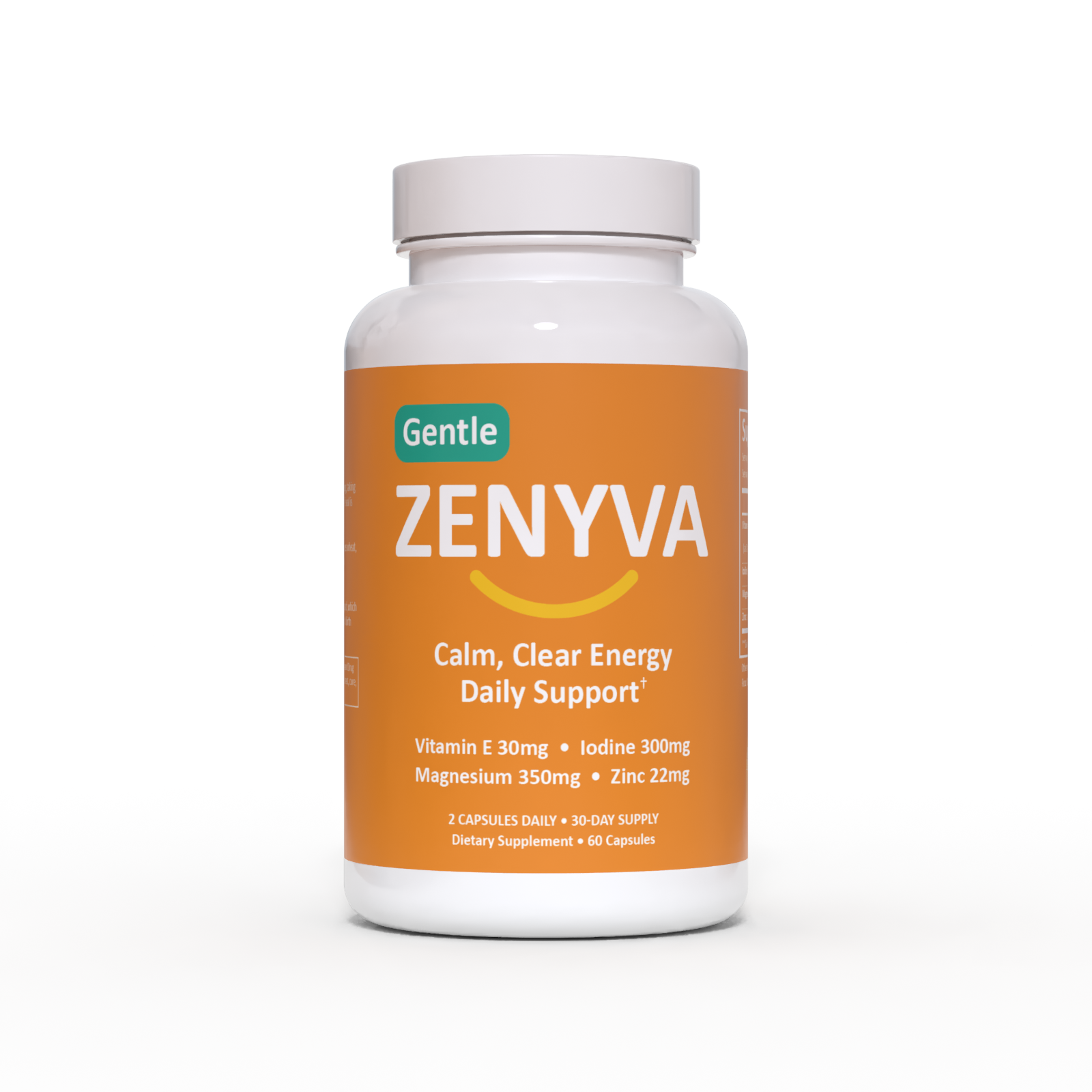
ZENYVA delivers 30mg of natural mixed tocopherols from cold-pressed sunflower oil. This includes alpha, beta, gamma, and delta tocopherols in the ratios found in natural food sources — not one molecule in isolation.
Why 30mg? The RDA is 15mg alpha-tocopherol equivalent. ZENYVA targets 2X the clinical threshold, consistent with the systems-based formulation approach: clinical benefits for cellular membrane protection, immune enhancement, and cardiovascular antioxidant support appear at 20–40mg of mixed tocopherols in human trials. 30mg is the evidence-backed midpoint where meaningful protection is achieved without approaching the elevated-dose territory where high-alpha supplementation may suppress gamma.
The form is cold-pressed, not solvent-extracted. The spectrum is mixed, not isolated. The dose is 2X the RDA, not 100% of a survival standard. And the molecule is recognized by human alpha-TTP, not filtered as foreign and excreted.
The Industry Will Not Fix This
The Vitamin E form problem will not be solved by regulation. The FDA does not distinguish between natural and synthetic forms in labeling requirements. The USP does not require tocotrienol inclusion. Consumer education is the only mechanism — and the industry benefits from continued ignorance.
This is why ZENYVA publishes this research. Not to sell a product, but because the data exists, the gap is measurable, and the consumer deserves to know that “Vitamin E” on a label can mean eight different things — or only one, and the wrong one.
References
- Traber, M.G. & Atkinson, J. (2007). Vitamin E, antioxidant and nothing more. Free Radical Biology and Medicine.
- Helzlsouer, K.J. et al. (2000). Association between alpha-tocopherol, gamma-tocopherol, selenium, and subsequent prostate cancer. Journal of the National Cancer Institute.
- Jiang, Q. et al. (2001). Gamma-tocopherol and its major metabolite, in contrast to alpha-tocopherol, inhibit cyclooxygenase activity. Proceedings of the National Academy of Sciences.
- Sen, C.K. et al. (2006). Tocotrienol: the natural vitamin E to defend the nervous system? Annals of the New York Academy of Sciences.
- Parker, R.A. et al. (1993). Tocotrienols regulate cholesterol production in mammalian cells by post-transcriptional suppression of HMG-CoA reductase. Journal of Biological Chemistry.
- Institute of Medicine (2000). Dietary Reference Intakes for Vitamin C, Vitamin E, Selenium, and Carotenoids. National Academies Press.